

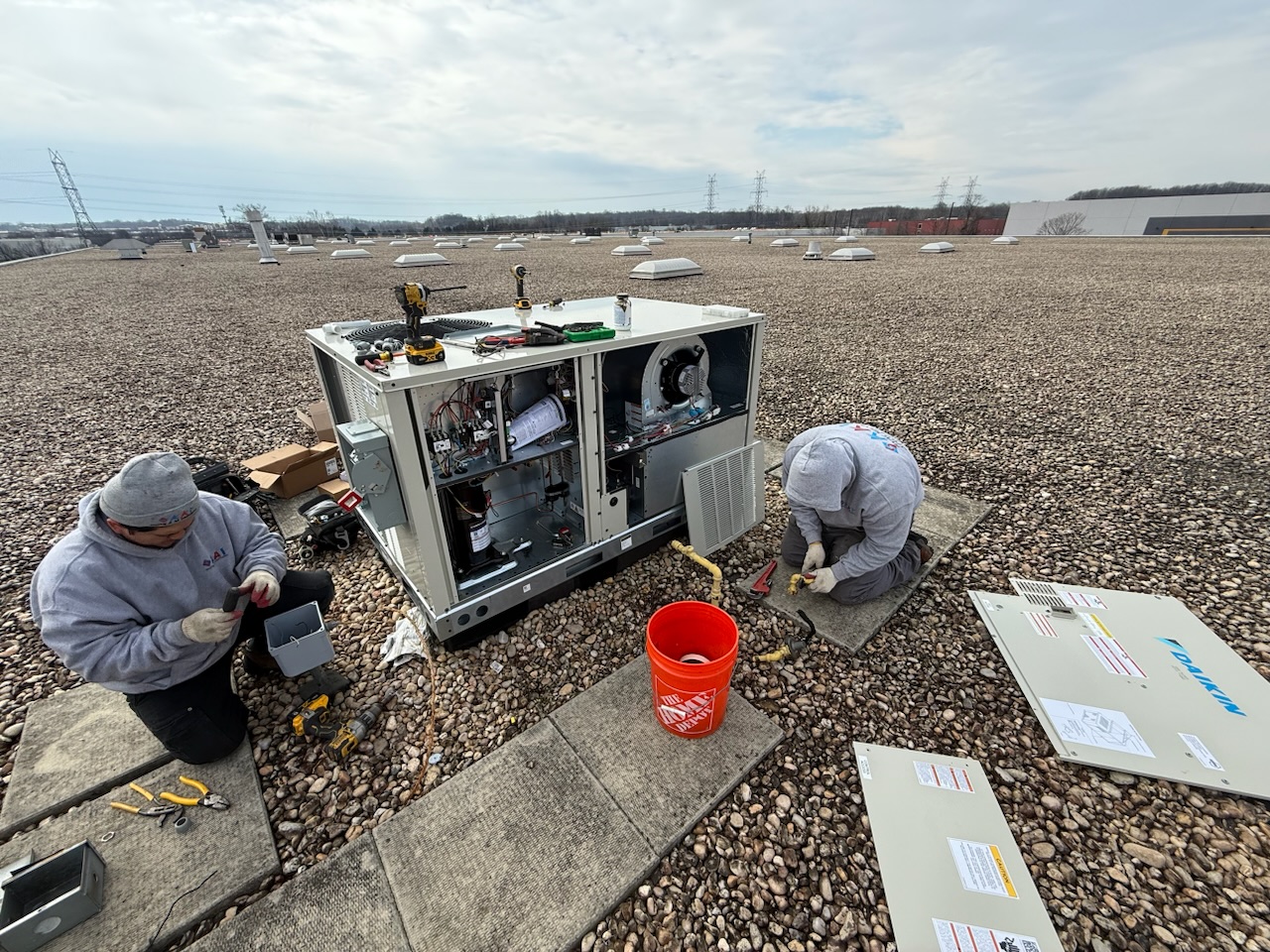
You can keep running and repairing the R-410A equipment your building already has. The phase-out limits new equipment: since January 1, 2025, most new air conditioning and heat pump equipment has to use a refrigerant with a global warming potential (GWP) below 700, and R-410A’s GWP is about 2,088. In May 2026, EPA removed a deadline that would have stopped the installation of R-410A systems built before 2025, so some of that equipment can still go in.
At Arminco Air (AAI), we install, repair and maintain commercial HVAC systems for office buildings, warehouses, data centers and other commercial facilities across Northern Virginia, Washington DC and Maryland, from our office in Sterling, Virginia. This guide explains the rules as they stand in October 2026: which commercial equipment they cover, what changed this year, and how they affect your next replacement.
What is the R-410A phase-out?
The R-410A phase-out is the move away from high-GWP refrigerants required by the American Innovation and Manufacturing (AIM) Act of 2020. EPA runs it through two programs:
- The HFC phasedown caps how much HFC refrigerant can be produced and imported in the US. The cap stepped down to 60% of the historic baseline in 2024, drops to 30% in 2029 and reaches 15% in 2036, an 85% cut overall.
- The Technology Transitions rule sets a GWP limit for new equipment, sector by sector. For most new air conditioning equipment, the refrigerant’s GWP has to stay below 700.
R-410A is an HFC blend. With a GWP near 2,088, it sits far above the 700 limit, so manufacturers have moved new equipment to lower-GWP refrigerants such as R-454B and R-32.
What changed in 2026?
EPA published a final rule in the Federal Register on May 26, 2026 (document 2026-10387). Two changes matter most for commercial buildings:
- The January 1, 2026 installation deadline is gone for residential and light commercial air conditioning and heat pump systems built from components made or imported before January 1, 2025. Those systems can now be installed until the existing stock runs out.
- Cold storage warehouses got a higher limit. New cold storage warehouse systems can use refrigerants with a GWP below 700, instead of the earlier 150 or 300 limits, through January 1, 2032.
For comfort air conditioning, the 700 limit on newly made equipment stays in place. Source: EPA’s fact sheet on the May 2026 rule.
Which commercial equipment do the rules cover?
The limits depend on the type of equipment. As of October 2026, the federal rules (40 CFR 84.54) say:
| Equipment | New equipment must be below this GWP | What it means for R-410A |
|---|---|---|
| Residential and light commercial AC and heat pumps | 700 | New products made or imported from January 1, 2025 must meet the limit. Systems built from components made before that date can still be installed, with no end date. |
| Variable refrigerant flow (VRF) systems | 700 | R-410A VRF systems can be installed until January 1, 2027 if all their components were made or imported before January 1, 2026. Projects with a building permit issued before October 5, 2023 have until January 1, 2028. |
| Chillers for comfort cooling | 700 | New chillers made or imported, and new chiller installations, have had to meet the limit since January 1, 2025. |
| Cold storage warehouse systems | 700 (raised in 2026) | The higher limit runs through January 1, 2032. |
EPA’s rules don’t name rooftop units on their own. Whether a packaged unit counts as light commercial depends on its type, and the manufacturer’s data sheet lists its refrigerant.
Can you still install R-410A systems in 2026?
Sometimes. A light commercial R-410A system can still be installed if its specified components (condensing units, condensers, compressors, evaporator units and evaporators) were made or imported before January 1, 2025. An R-410A VRF system has until January 1, 2027, if its components were made before January 1, 2026. A new comfort-cooling chiller has to use a refrigerant below the 700 limit.
In practice, that pre-2025 stock keeps shrinking. If a quote includes R-410A equipment, ask for the manufacture dates of the main components, so you know the installation is allowed.
Can you keep running and repairing R-410A equipment?
Yes. EPA’s rules don’t limit the use of existing equipment, and you can keep repairing your existing systems. Manufacturers can still make R-410A replacement parts, such as condensing units, as long as they’re labeled for servicing existing equipment only (EPA’s HFC questions page).
The open question is refrigerant supply. The production cap keeps falling, and EPA itself notes that HFCs and parts may become harder to find over time. The Air Conditioning Contractors of America has also warned that R-410A refrigerant prices could rise. A system with a slow leak costs more to keep topped up each year, so fix leaks early.
What are A2L refrigerants, and what changes on a job?
A2L is a safety class: lower toxicity and lower flammability. R-454B (GWP 466) and R-32 (GWP 675) are the two A2L refrigerants most US manufacturers now use in new comfort-cooling equipment. They’re mildly flammable, so the equipment and the work change:
- Many new A2L units include a refrigerant leak sensor that starts the fan if refrigerant leaks.
- Technicians follow handling, recovery and storage steps written for flammable refrigerants.
- Building and mechanical codes have been updated to allow A2L systems, with rules on charge size and room size.
R-454B is not a drop-in replacement for R-410A. You can’t top up an existing R-410A system with it, and replacing one part of a split system with A2L equipment usually means replacing the matching part too.
How does the phase-out change the repair-or-replace decision?
It adds one more question to the usual ones about age, repair history and energy use: how much longer can you keep this refrigerant in the system?
Repair usually makes sense when the unit is mid-life, the failure is a single part, and the system holds its charge. Replacement moves up the list when:
- the compressor or a coil fails on a unit near the end of its service life;
- the system leaks R-410A again and again;
- replacing the condensing unit would force a new indoor coil anyway.
Our guide to repairing or replacing a commercial HVAC system covers the rest of that decision. For rooftop equipment, see our rooftop unit replacement page.
Do the new leak repair rules apply to your building?
They may, if you have larger systems. From January 1, 2026, EPA’s leak repair rule (40 CFR 84.106) covers appliances with a full charge of 15 pounds or more of a refrigerant that contains an HFC, such as R-410A, or a substitute with a GWP above 53. A comfort-cooling appliance that leaks more than 10% of its charge a year has to be repaired, and the threshold for commercial refrigeration is 20%.
The rule excludes residential and light commercial air conditioning and heat pumps. It reaches chillers, larger commercial systems and refrigeration. Keep a record of each leak check and refrigerant addition, because those records show you’re in compliance. A commercial HVAC maintenance plan puts those checks on the calendar.
What does the 2026 rule mean for cold storage?
It gives you more refrigerant choices for a new cold storage warehouse system until 2032. Before the May 2026 rule, new systems in that sector faced a 150 or 300 GWP limit, depending on the system. New systems now have to stay below 700 through January 1, 2032, and then the lower limits return.
If you’re planning a new refrigerated warehouse or a major refrigeration upgrade, ask your contractor which refrigerants the design allows today and in 2032. Our cold storage HVAC page covers the systems we work on.
What should facility managers do now?
Start with a list of what you have, then plan replacements before a failure forces the decision.
- List each unit: type, location, age, tonnage, refrigerant and condition.
- Mark the units near the end of their service life and budget for replacing them over the next few years.
- Ask for manufacture dates on any quote for R-410A equipment.
- Check which systems fall under the leak repair rule and start keeping leak records.
- Schedule larger replacements outside peak cooling season, when equipment and crews are easier to book.
Planning an R-410A replacement in Northern Virginia, DC or Maryland
Arminco Air (AAI) works on commercial and industrial buildings only. We install new commercial HVAC systems, replace rooftop units, and repair existing R-410A equipment across Northern Virginia, Washington DC and Maryland. If a system has already failed, our commercial HVAC repair team handles emergencies 24/7. Call (703) 430-7100 or send us a message to talk through your equipment.
Frequently asked questions
Is R-410A being banned?
No. You can keep using and repairing existing R-410A equipment. The rules limit new equipment: most new air conditioning equipment made since January 1, 2025 has to use a refrigerant with a GWP below 700.
Can you still install R-410A systems in 2026?
In some cases. Light commercial systems built from components made or imported before January 1, 2025 can still be installed. R-410A VRF systems with components made before January 1, 2026 can be installed until January 1, 2027.
How long will R-410A refrigerant be available?
EPA hasn’t set an end date for servicing. Production and imports of HFCs are capped and keep falling, to 15% of the historic baseline in 2036, so supply is expected to tighten over time.
What refrigerant is replacing R-410A?
Most new comfort-cooling equipment uses A2L refrigerants, mainly R-454B and R-32. They have GWPs of 466 and 675, under EPA’s limit of 700.
Does the phase-out apply to VRF systems?
Yes. New VRF systems have to use a refrigerant with a GWP below 700. R-410A VRF systems can still be installed until January 1, 2027 if all their components were made or imported before January 1, 2026.