

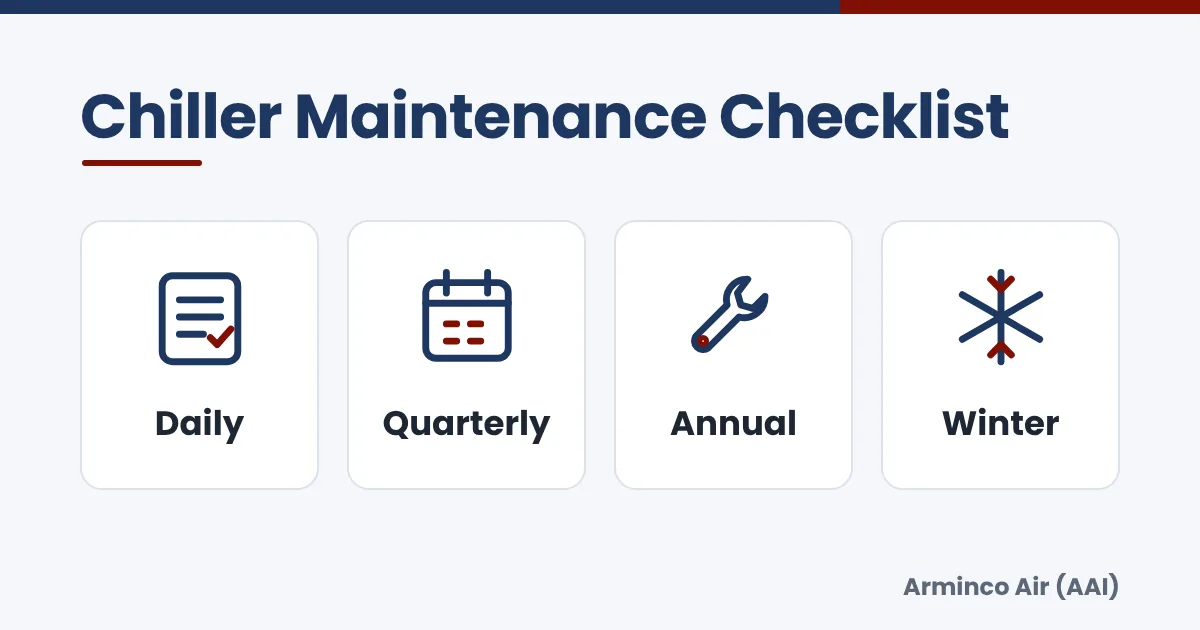
A chiller maintenance checklist splits the work by how often it needs doing. Building staff log the chiller’s readings every day and look for leaks and alarms. A technician inspects it every quarter. Once a year it gets a full service: tubes cleaned, oil tested, refrigerant leak-checked, and every control and safety tested. Before winter, chillers and cooling towers that sit outdoors also need freeze protection.
At Arminco Air (AAI), we repair and maintain commercial chillers for data centers, office buildings and industrial facilities across Northern Virginia, Washington DC and Maryland, from our office in Sterling, Virginia. A chiller is usually the most expensive piece of HVAC equipment in a building, and most of its expensive failures start as small changes in its readings. Below is what to check, how often, and who should do it.
How often should a chiller be serviced?
Have a technician service it every quarter, and give it a full annual service once a year. Between visits, your operators or facility team should record its readings daily, or at least weekly. Buildings that can’t lose cooling for even an hour, such as data centers, sometimes add monthly technician checks.
What are the main parts of a chiller?
Every chiller has four main parts:
- Compressor: pumps refrigerant through the system. Usually the most expensive part to repair.
- Evaporator: where the refrigerant takes heat out of the building’s chilled water.
- Condenser: where that heat leaves, either to a cooling tower (water-cooled chillers) or to the outside air through coils and fans (air-cooled chillers).
- Expansion device: drops the refrigerant’s pressure before it goes back to the evaporator.
The controls, pumps, water treatment and, on water-cooled systems, the cooling tower all have to work for the chiller to work, so a good checklist covers them too.
What should operators check every day?
Keep a log. The point is the trend, not a single reading. Each day or shift, record:
- Chilled water temperature going out and coming back
- Condenser water temperatures in and out (water-cooled), or outdoor temperature (air-cooled)
- Refrigerant pressures in the evaporator and condenser
- Oil pressure and oil level, if the gauges or controller show them
- Compressor amps or percent load
- Any alarms, and whether they cleared on their own
Then walk around the chiller. Look for oil stains or oily dust on joints, which often mark a refrigerant leak. Listen for new noises and feel for new vibration. Check that the pumps are running and the strainers aren’t showing a high pressure drop.
If the gap between the leaving chilled water temperature and the refrigerant temperature in the evaporator keeps growing, the tubes are probably fouling. Catching that in the log costs a cleaning. Missing it costs efficiency every hour the chiller runs, and eventually a high-pressure trip on a hot afternoon.
What does a quarterly chiller service include?
A quarterly visit is a technician’s inspection with the chiller running. It should cover:
- Electrical: tighten connections, check starters and contactors for pitting or heat damage, and compare motor amps to the nameplate.
- Refrigerant circuit: check the charge (sight glass, superheat and subcooling, or the controller’s readings) and leak-check suspect joints.
- Safeties and controls: confirm that low- and high-pressure cutouts, flow switches and freeze protection work, and that sensors read correctly.
- Water side: clean strainers, check flow and pressure drop across the evaporator and condenser, and review water treatment test results.
- Air-cooled chillers: clean the condenser coils and check the fans and fan motors.
- Operating log: a technician should read your log, not just the chiller on the day, and flag trends.
Ask for a written report after each visit. It’s how you plan next year’s budget and spot a chiller heading for a major repair.
What belongs in the annual chiller service?
The annual service is the big one, usually done when the cooling load is lowest:
- Clean the condenser tubes on water-cooled chillers, by brushing or by chemical cleaning, and inspect the evaporator tubes. Every few years, an eddy current test of the tubes finds thinning before a tube fails.
- Test the oil. An oil analysis shows wear metals, moisture and acid. Change the oil and filters based on the results and the manufacturer’s schedule.
- Leak-test the whole refrigerant circuit and update the service records.
- Test the motor windings with a megohmmeter to catch insulation breaking down.
- Recalibrate controls and sensors and test each safety, interlock and alarm.
- Check vibration on compressors, pumps and fans, and compare it with last year’s.
- Service the cooling tower on water-cooled systems: clean the basin, inspect the fill and drift eliminators, check the fan and gearbox, and confirm the water treatment program. Our cooling tower service page covers that side.
How do you get a chiller ready for winter in Northern Virginia?
Protect anything that holds water outdoors. Northern Virginia winters bring regular hard freezes, and a frozen evaporator or cooling tower basin can crack and turn a seasonal shutdown into a replacement.
- Air-cooled chillers outdoors: test the glycol concentration, or drain the evaporator if the chiller will sit idle, and check that heat tape and freeze-protection controls work.
- Cooling towers: drain them, or confirm the basin heaters work if the tower runs through winter.
- Chillers that shut down for winter: follow the manufacturer’s seasonal shutdown steps, and log the readings at shutdown so the spring start-up has something to compare against.
- Chillers that run all year: data centers often need cooling around the clock, winter included, and some switch to free cooling when it’s cold outside. Test that switchover before the first cold snap, not during it.
What are the warning signs a chiller needs service now?
Call a technician if you see:
- Chilled water running warmer than its setpoint, or zones that won’t cool
- High-pressure or low-pressure trips, especially repeat trips
- Oil stains, or refrigerant that needs topping up again and again
- New noise, vibration or a burning smell
- The compressor drawing more amps than usual for the same load
- The chiller short cycling, or running flat out without catching up
A chiller that trips and resets itself is telling you something. Resetting it over and over can turn a sensor or flow problem into a compressor failure.
Do refrigerant rules affect chiller maintenance?
Yes. Most commercial chillers hold enough refrigerant to fall under the EPA’s leak repair and record-keeping rules: Section 608 for older refrigerants, and a newer rule under the AIM Act for HFC refrigerants such as R-134a and R-410A. Your service records are part of compliance, so keep each leak check and refrigerant addition on file. Chillers that still run on older refrigerants such as R-22 or R-123 are also getting more expensive to service, which belongs in the repair-or-replace conversation. Our guide to the R-410A phase-out explains the HFC leak repair rule and what the refrigerant changes mean for new equipment.
When is a chiller closer to replacement than repair?
When major repairs keep coming back, or the chiller is near the end of its service life. Well-maintained chillers often run 20 years or more, in line with ASHRAE’s equipment service life data. If yours is close to that age, needs a compressor or a full tube bundle, or runs on a refrigerant that’s being phased out, ask for a repair quote and a replacement quote at the same time and compare them. Our commercial chiller repair and maintenance page covers the chiller types we work on.
What does a maintenance agreement add?
It puts scheduled maintenance visits on the calendar, so nobody has to remember them. With an Arminco Air maintenance agreement, your chiller gets scheduled visits, and agreement customers get a technician on site within four hours. See what’s included on our commercial HVAC maintenance page.
Chiller maintenance in Northern Virginia, DC and Maryland
Arminco Air maintains and repairs chillers for data centers, office buildings, cold storage and industrial facilities across Northern Virginia, Washington DC and Maryland. We work on commercial and industrial buildings only. For computer rooms, see our guide to CRAC and CRAH units. Call (703) 430-7100 or send us a message. If a chiller has already failed, our commercial HVAC repair team handles emergencies 24/7.
Frequently asked questions
How often should a commercial chiller be serviced?
Every quarter by a technician, plus a full annual service. Operators should log its readings daily or weekly in between. Buildings that can’t lose cooling, like data centers, sometimes add monthly checks.
What is included in chiller maintenance?
Daily or weekly logs of temperatures, pressures, oil and amps; quarterly checks of electrical parts, refrigerant charge, safeties, controls and the water side; and an annual service that cleans the condenser tubes, tests the oil, leak-checks the refrigerant circuit and recalibrates the controls.
What's the difference between maintaining an air-cooled and a water-cooled chiller?
Water-cooled chillers need condenser tube cleaning, water treatment and cooling tower maintenance. Air-cooled chillers need clean condenser coils, working fans and, outdoors in Northern Virginia, freeze protection for winter.
Why does my chiller keep tripping on high pressure?
The most common causes are fouled condenser tubes or coils, low condenser water flow, a cooling tower that isn’t rejecting enough heat, or non-condensable gases in the refrigerant circuit. Repeat trips need a technician, not repeated resets.
Do you service chillers in data centers?
Yes. Arminco Air maintains and repairs chillers and precision cooling for data centers across Northern Virginia, including Loudoun County, along with CRAC and CRAH units.