

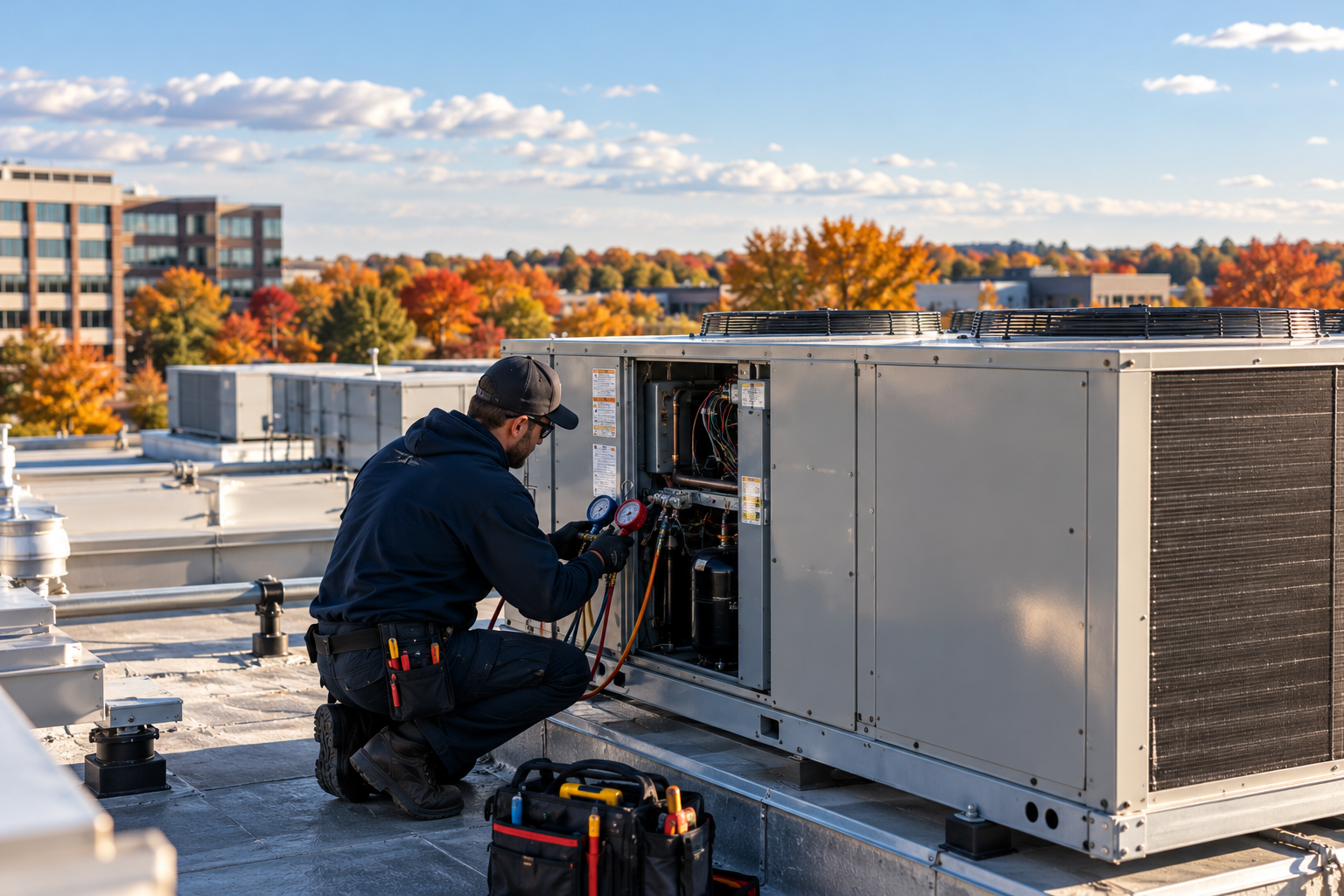
Rooftop unit maintenance before heating season comes down to five things: a safe, clean-burning heat section, fresh filters, an economizer that closes, clear condensate drains and a dry, sealed curb. Book the fall visit before the first hard frost. A rooftop unit that has sat on cooling all summer shows its heating problems on the first cold morning, usually with tenants already in the building.
At Arminco Air (AAI), we service and replace commercial rooftop units across Northern Virginia, Washington DC and Maryland from our office in Sterling, Virginia. A seasonal visit is the simplest way to catch a heating problem before it turns into a no-heat call. Below is what a fall rooftop unit service should include, what your own facility team can check, and how to tell when a unit is closer to replacement than repair.
How often should a rooftop unit be serviced?
At least twice a year: once in spring before cooling season and once in fall before heating season. Filters usually need changing more often, every one to three months depending on the building and the filter type. Buildings with heavy dust, commercial kitchens or high occupancy may need quarterly visits.
What should a fall rooftop unit service include?
A fall visit switches the unit from cooling to heating and checks everything that has to work in cold weather. A complete visit covers:
- Gas heat section: inspect the burners and heat exchanger for cracks, rust and soot, check the flame and the ignition sequence, test the flame sensor and safety limits, and run a combustion analysis.
- Heat pump, if your units have one: check defrost operation and the reversing valve.
- Filters: replace them. A clogged filter cuts airflow, and low airflow can trip the heat section on its high-limit switch.
- Economizer and dampers: confirm the outdoor air damper opens and closes fully, the linkage moves freely, and the controls drop back to minimum outdoor air in cold weather. A damper stuck open in January pulls freezing air straight into the building.
- Belts, bearings and blower: look for cracked or glazed belts, check tension and alignment, and listen for worn bearings.
- Electrical: tighten connections, check contactors for pitting, and measure motor amps.
- Condensate drain and trap: clear the line and pan. Water left standing in a rooftop trap can freeze and back up into the unit.
- Controls and schedules: check thermostat or building automation setpoints and occupied and unoccupied schedules, and confirm the unit actually heats when called.
- Cabinet, curb and roof penetrations: make sure access panels are secured, gaskets seal, and the curb flashing is intact. A leaking curb often gets blamed on the roof.
Ask for a written report on each unit, with photos of anything that needs attention. On a roof with ten or twenty units, that report is how you plan next year’s budget.
Why is the heat exchanger the most important fall check?
A cracked heat exchanger can let combustion gases, including carbon monoxide, into the air the unit supplies to the building. On a unit heating an office, a classroom or a medical suite, that makes it a safety problem first. A technician should inspect it visually and confirm with a combustion analysis. If the heat exchanger is cracked, the heat section should stay off until it is repaired or the unit is replaced.
What can your own facility team check?
Your maintenance staff can handle a few things between professional visits, as long as roof access is safe and your building’s policy allows it:
- Walk the roof after storms and look for debris on coils, loose panels and standing water around curbs.
- Change filters on schedule and write the date on the unit.
- Watch for warning signs inside: a zone that won’t hold temperature, a burning smell that lasts more than the first few minutes of the season (dust burning off is normal at first), short cycling, a noisy blower, or water stains on ceiling tiles below a unit.
Leave anything inside the gas, electrical or refrigerant sections to a licensed technician.
What problems show up when heating season starts?
The same handful of faults come up most falls:
- The unit won’t light, usually an ignition or flame sensor fault.
- The burner lights, then shuts off, often a limit switch tripping because of a dirty filter or a weak blower.
- The unit blows cold air in heat mode, from an economizer stuck open, a gas valve fault or a control schedule that never switched over.
- The unit short cycles or trips its breaker because a component is wearing out.
Most of these are quick fixes on a mild October afternoon. On a 20-degree January morning, the same fix comes with a cold building, unhappy tenants and an emergency call.
Does Northern Virginia’s weather change the schedule?
Yes. Northern Virginia’s humid summers work rooftop units hard on cooling, and its winters get cold enough to freeze drain lines and trip safeties. The first frosts usually arrive in mid-fall, often earlier in the outer parts of Loudoun County than inside the Beltway. Book fall rooftop service for September or October so any parts on order arrive before you need the heat.
When is a rooftop unit closer to replacement than repair?
When the repairs keep coming back, or the unit is near the end of its working life. ASHRAE’s equipment life data puts the median service life of a rooftop unit at about 15 years. Other signs: a cracked heat exchanger on an older unit, a unit still running R-22 refrigerant, which has not been produced or imported in the US since 2020 and keeps getting harder to buy, or repair quotes that make up a growing share of what replacement would cost.
Our rooftop unit replacement and service page explains how we assess repair versus replacement and what a replacement involves, from site survey to the crane lift. From the site survey to the crane lift, a rooftop replacement typically takes three to seven business days, depending on unit availability, permit review and crane and roof access scheduling. We pull the mechanical permit.
What does a maintenance agreement add?
It puts maintenance visits on the calendar so nobody has to remember them, and it moves you up the line when something fails. AAI maintenance plans include seasonal visits and priority emergency service. See what’s included on our commercial HVAC maintenance page, or read how commercial HVAC maintenance plans work in Northern Virginia.
Book fall rooftop unit service
AAI services and replaces rooftop units for office buildings, retail centers, warehouses, medical offices and other commercial properties across Northern Virginia, Washington DC and Maryland. We work on commercial and industrial buildings only. Call (703) 430-7100, Monday to Friday, 8am to 4pm, or send us a message. If a unit has already failed, our commercial HVAC repair team handles emergencies 24/7.
Frequently asked questions
How often should a commercial rooftop unit be serviced?
At least twice a year, in spring before cooling season and in fall before heating season. Change filters every one to three months between visits. Dusty buildings, kitchens and high-occupancy spaces may need quarterly service.
How long does a rooftop unit last?
ASHRAE’s equipment life data puts the median service life of a rooftop unit at about 15 years. Units that get regular maintenance tend to reach it; neglected units often fail sooner, usually at the heat exchanger or the compressor.
What is included in rooftop unit maintenance?
A full visit covers the heat section (burners, heat exchanger, ignition, safeties and combustion), filters, economizer and dampers, belts and blower, electrical connections, condensate drains, controls and schedules, and the cabinet and curb. Fall visits focus on heating; spring visits focus on coils, refrigerant and cooling.
Why is my rooftop unit blowing cold air on heat?
The most common causes are an economizer damper stuck open, an ignition or flame sensor fault, a gas valve problem, or a control schedule that never switched to heating. A dirty filter can also trip the high-limit switch and shut the burners off while the fan keeps running.
Is Arminco Air licensed in Virginia?
Yes. AAI holds a Class A contractor license, number 2705183187, the highest of Virginia’s three contractor classifications. You can verify it on the Virginia DPOR license lookup.