

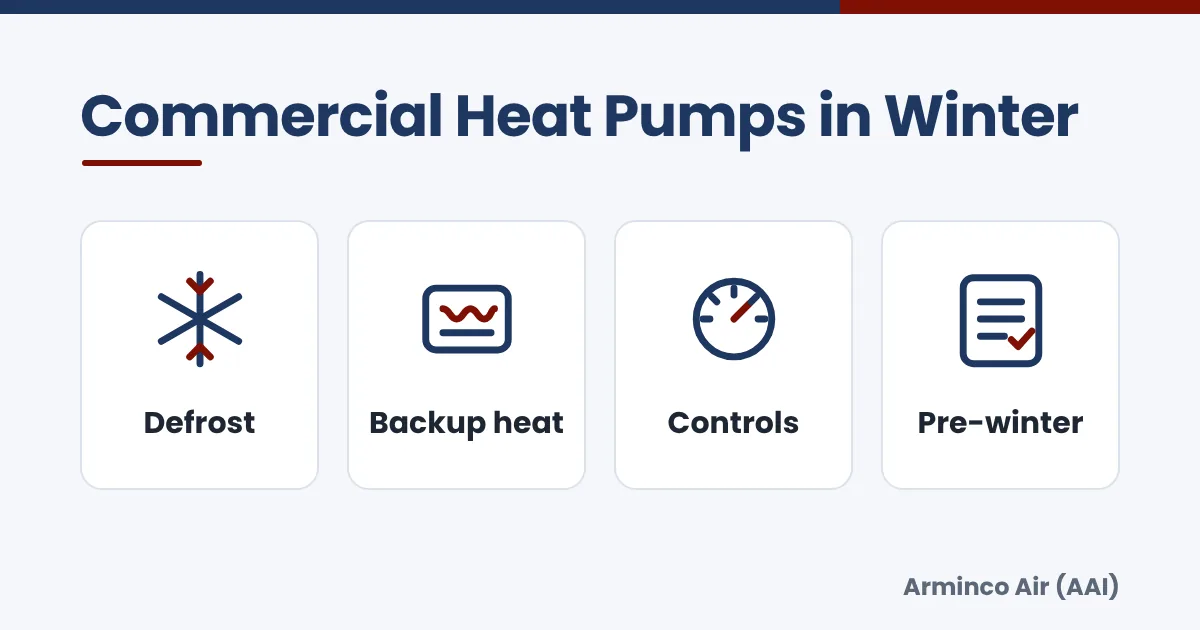
Commercial heat pumps keep heating through a Northern Virginia winter, but they behave differently once it gets cold. As the outdoor temperature drops, a heat pump puts out less heat and works harder for it. It stops now and then to defrost its outdoor coil. On the coldest mornings, backup heat may carry part of the load. None of that is a fault. Knowing what’s normal, and getting the system checked before the first hard freeze, is what keeps the building warm and the energy bill predictable.
At Arminco Air (AAI), we install, repair and maintain commercial heat pumps, including packaged rooftop heat pumps, split systems and VRF systems, for offices, warehouses, retail spaces and medical offices across Northern Virginia, Washington DC and Maryland, from our office in Sterling, Virginia. Here’s what facility managers should expect from a heat pump this winter, and what to check now.
Do heat pumps work in Northern Virginia winters?
Yes. January lows at Dulles average about 26°F, according to WeatherSpark’s climate data, and a heat pump still pulls useful heat out of air that cold. What changes is how much. Every heat pump has a balance point: the outdoor temperature where the building loses heat as fast as the heat pump can supply it. Above it, the heat pump handles the building on its own. Below it, backup heat makes up the difference. A well-sized system in a reasonably tight building sits below its balance point for only a small share of the winter.
What types of heat pumps do commercial buildings use?
Commercial buildings here mostly use one of three types of air-source heat pump:
- Packaged rooftop heat pumps: a rooftop unit that heats and cools with one refrigerant circuit, common on offices, retail and single-story warehouses.
- Split heat pumps: an outdoor unit piped to an indoor air handler, often used for smaller offices, suites and tenant spaces.
- VRF systems: one outdoor unit serving many indoor units, each zone with its own control. Heat recovery VRF can heat some zones while it cools others, which suits buildings with sunny and shaded sides or interior rooms that need cooling all year.
All three work on the same principle, so the winter advice below applies to each of them.
Why does a heat pump lose heating capacity in cold weather?
A heat pump moves heat from the outdoor air into the building. The colder the outdoor air, the less heat it holds and the harder the compressor has to work to move it. Output drops and so does efficiency, measured as the coefficient of performance (COP), the units of heat delivered per unit of electricity. A heat pump that easily heats the building at 45°F may need help at 15°F.
That’s why sizing matters. A heat pump sized only for summer cooling can come up short on winter mornings, and the building then leans on backup heat far more than it should.
What is defrost mode, and is it normal?
Yes, defrost is normal. In heating mode the outdoor coil runs colder than the air around it, so moisture freezes on it, mostly when it’s damp and between about 20°F and 40°F outside. To clear the ice, the heat pump briefly reverses into cooling mode and sends warm refrigerant to the outdoor coil. The outdoor fan stops, you may see steam rising off the unit, and you may hear a whoosh as the reversing valve shifts. A typical defrost lasts a few minutes, then heating resumes.
What isn’t normal: a coil that stays encased in ice, defrost cycles that run back to back, or ice building up on the bottom of the unit and around the drain. Those point to a failed defrost sensor or control board, low refrigerant charge, a blocked drain path or a fan problem.
When does backup heat come on?
Backup heat comes on when the heat pump alone can’t hold the setpoint, during defrost (so the space doesn’t get a blast of cool air), and when someone raises the setpoint a long way at once. On commercial units it’s usually electric heat strips, or a gas heat section on a dual-fuel rooftop unit.
Electric backup heat costs much more to run than the heat pump itself, so check how your controls use it. Common culprits behind a high winter bill:
- A large morning warm-up after a deep night setback, which calls for backup heat every day
- Thermostats or the building automation system set to bring on backup heat too early
- A heat pump that’s low on refrigerant or has a failing compressor, so backup heat quietly does most of the work
A technician can set a lockout temperature for backup heat and stage the morning warm-up so the heat pump does most of the job. If your building runs on a building automation system, our building controls team can check that programming.
What are cold-climate heat pumps?
Cold-climate heat pumps are built to hold more of their capacity in very cold weather, usually with variable-speed compressors. ENERGY STAR’s cold climate criteria call for a COP of at least 1.75 at 5°F and at least 70% of the unit’s 47°F heating capacity at 5°F. That ENERGY STAR specification covers equipment under 65,000 Btu per hour, so many larger commercial units aren’t rated against it. For a big rooftop heat pump or a VRF system, ask the manufacturer for low-temperature capacity data and compare it with your building’s heating load.
How should you prepare a commercial heat pump for winter?
Have a technician check it in heating mode before the first hard freeze, usually in October or November. A good pre-winter visit covers:
- Reversing valve: confirm it shifts cleanly between cooling and heating.
- Defrost controls: test the defrost sensor and board, and run a defrost cycle.
- Refrigerant charge: check it in heating mode. A small undercharge that barely shows in summer can starve a heat pump in winter.
- Outdoor coil and fan: clean the coil and confirm the fan motor and blade are sound.
- Drain path: make sure meltwater from defrost can drain away and won’t refreeze under the unit.
- Electrical: tighten connections and check the contactor, capacitors and compressor amps.
- Backup heat: confirm it works and comes on only when it should.
- Controls: review setpoints, night setback and the morning warm-up schedule.
- Filters: replace them, since a clogged filter cuts airflow and heating output.
On rooftops, also keep a clear path to the units for winter service calls and keep snow from drifting against the coils. Our rooftop unit maintenance checklist covers the rest of a fall rooftop visit.
What are the warning signs a heat pump needs service?
Call a technician if you see:
- Cool or lukewarm air from the supply vents while the system is in heating mode
- An outdoor coil that stays iced over
- A system that runs on backup heat most of the day in mild weather
- Short cycling, or a unit that runs constantly without reaching setpoint
- Grinding, rattling or loud new noises from the outdoor unit
- A heating bill that jumps with no change in weather or occupancy
A heat pump that fails on a cold night can freeze pipes and close a building. If you lose heat, our commercial HVAC repair team handles emergencies 24/7.
Should you replace an old heat pump with a new heat pump?
It depends on the building. A new heat pump makes sense where the electrical service supports it and the heating load fits what the equipment can deliver in cold weather. A dual-fuel rooftop unit, with a heat pump plus a gas heat section, is another option for buildings with gas service. New heat pumps also use different refrigerants: equipment installed today generally runs on lower-GWP refrigerants such as R-454B or R-32 instead of R-410A. Our guide to the R-410A phase-out explains what that means for repair and replacement decisions. For rooftop equipment, see our rooftop unit replacement page.
Commercial heat pump service in Northern Virginia, DC and Maryland
Arminco Air installs, repairs and maintains commercial heat pumps, rooftop units and VRF systems for commercial and industrial buildings across Northern Virginia, Washington DC and Maryland. We don’t work on homes. With a commercial HVAC maintenance agreement, your heat pumps get scheduled maintenance visits and priority emergency service, and agreement customers get a technician on site within four hours. Call (703) 430-7100 or send us a message.
Frequently asked questions
Do commercial heat pumps work below freezing?
Yes. Heat pumps keep heating below 32°F, though their output and efficiency drop as it gets colder. Below the system’s balance point, backup heat makes up the difference. In Northern Virginia, where January lows at Dulles average about 26°F, a properly sized system runs on the heat pump alone for most of the winter.
Why is steam coming off my heat pump in winter?
It’s almost always the defrost cycle. The heat pump briefly reverses to melt ice off the outdoor coil, and the meltwater gives off steam in cold air. The outdoor fan stops during defrost and heating resumes after a few minutes.
Why is my heat pump running on backup heat so much?
Common causes are a deep night setback followed by a big morning warm-up, controls that bring on backup heat too early, low refrigerant, or a failing compressor. A technician can check the system in heating mode and set a lockout temperature for backup heat.
When should a commercial heat pump be serviced for winter?
Before the first hard freeze, usually in October or November. The visit should test the reversing valve and defrost controls, check the refrigerant charge in heating mode, clean the outdoor coil and confirm backup heat works.
Does Arminco Air service VRF heat pump systems?
Yes. Arminco Air installs, repairs and maintains VRF systems, packaged rooftop heat pumps and split heat pumps for commercial buildings across Northern Virginia, Washington DC and Maryland.